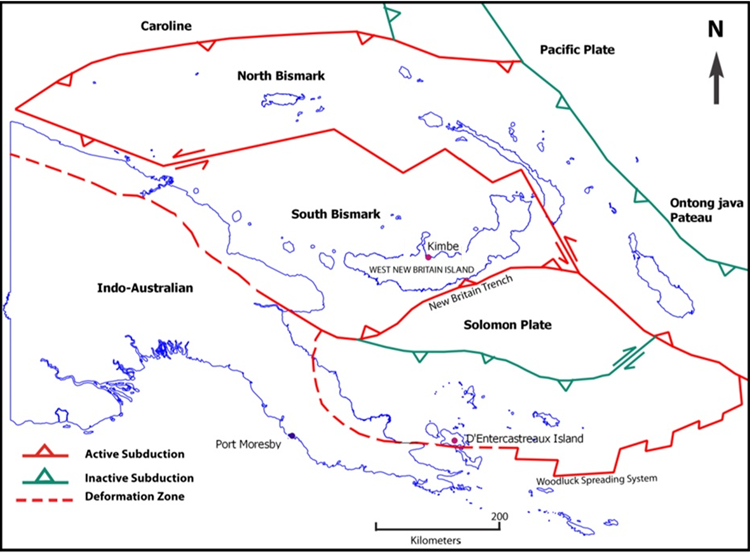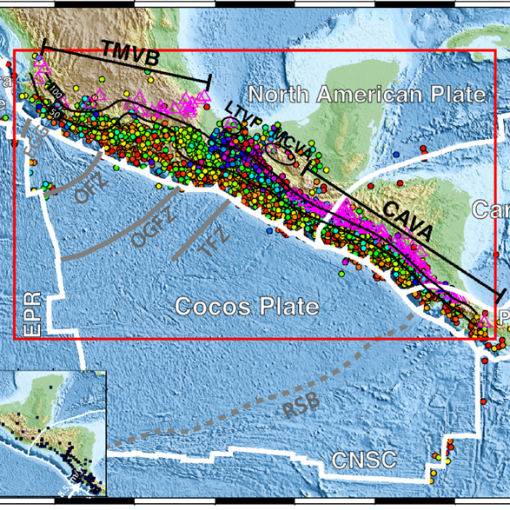
- Papua New Guinea (PNG) formed with the collision of three tectonic plates: Australia Plate moving north, Pacific Plate moving west-northwest, and the Caroline Plate moving east. A number of microplates were formed between the Australian and Pacific Plates. A series of geological terranes were formed over geological time.
- The Australia Craton supports the Fly Platform and mainland PNG. The New Guinea Orogen is the mountains along the center of the mainland and was caused by these plate collisions. The Melanesian Volcanic Arc consists of the islands to the north-northeast of the mainland orogen.
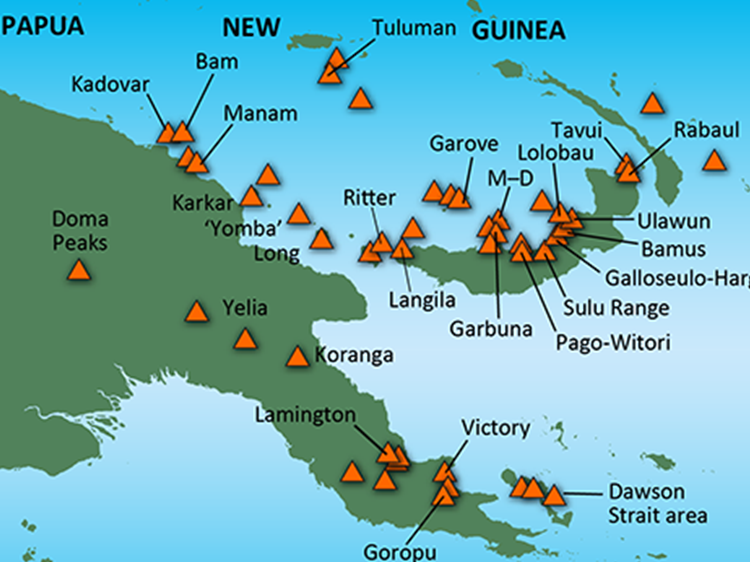
- The mainland volcanic systems are mostly inactive, but the Manam island volcano located close to the northern coast is active. The volcanic islands (Karkar, Long Island, Lamington, Rabaul, Tavui, Dakataua, and Krummel-Garbuna-Welcker) were formed above the subduction zones of some of these plate and microplate boundaries.
- Other volcanic island arc locations have surface manifestations with thermal springs, fumaroles, and vents demonstrating significant subsurface heat flux is present.
- The large island of New Britain is one of the most active geothermal locations with 27# volcanic systems, 7# having been active in historic times with 101# eruptions since 1700. The island is located on the ~1000km long Bismarck Volcanic Arc which is above the subducting Solomon Sea Plate. The Willaumez Peninsula on New Britain has evidence of ~40,000 years of volcanic activity. The active Garbuna Group of volcanoes is located on the southern end of this peninsula has three volcanic peaks on a shield volcano as well as a large ther