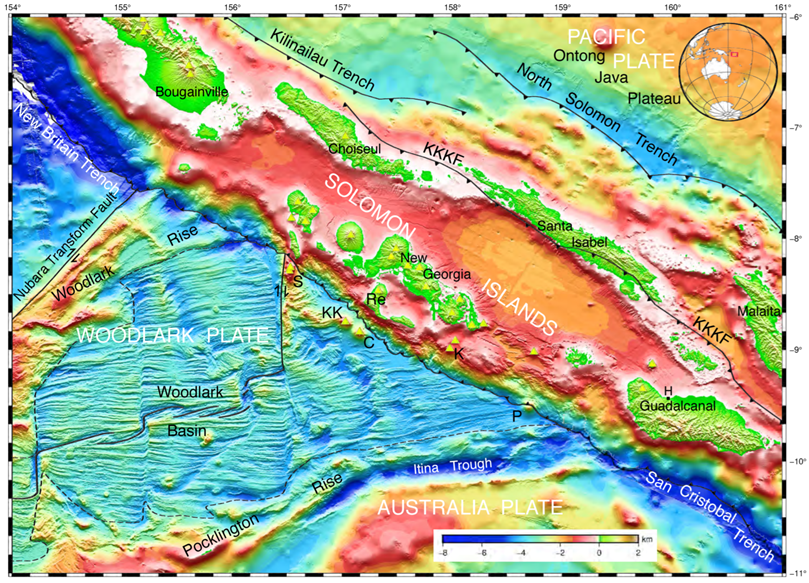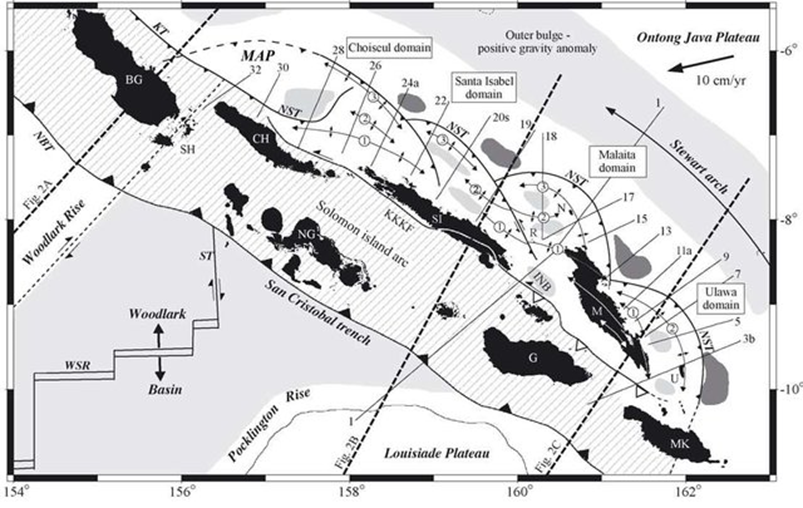
- The Solomon Islands formed along the converging Australian and Pacific Plates but there is a double sided subduction zone – in the northeast the Pacific Plate subducts beneath the Solomon Sea Plate and in the southwest the Australia Plate subducts beneath the Solomon Sea Plate.
- A complicating factor in this geology is the collision of the thick (>30km) Ontong Java Plateau in the Pacific Plate with the northern part of the Solomon Islands Arc. This collision resulted in a polarity reversal where the active subduction today is the Australia Plate beneath the Pacific Plate.
- The original and subsequent subduction systems affected where and how volcanic systems and islands developed across the Solomon Island Arc. A single linear chain of islands (Choiseul, Santa Ysabel, Guadalcanal and San Cristobal ) was separated by these events, leading to the formation of Malaita on the northside and the islands of New Georgia group on the southside – a double chain arc.
- The Solomon Islands has 8# Holocene volcanoes (Coleman, Gallego, Kana Keoki, Kavachi, Savo, Simbo, Tinakula, and East Kavachi) and 6# Pleistocene volcanoes (Kolombangara, Mbareke, Nggatokae, Nonda, Rendova, and Vangunu). Currently 3# are considered active (Savo, Tinakula, and Kavachi).
- Savo Island has been studied extensively with geological, geophysical, and geochemical fieldwork exploration to investigate geothermal energy development potential.