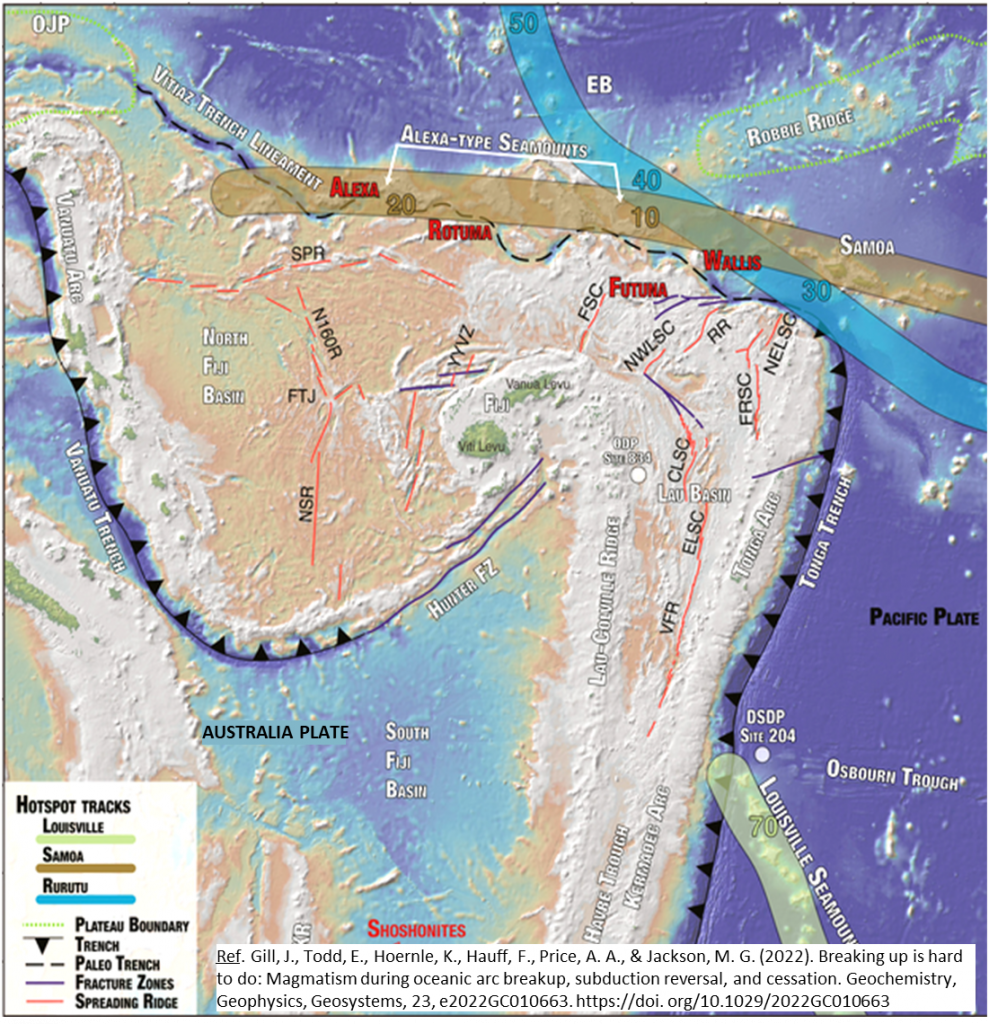
The geology of Fiji and its evolution as a volcanic island arc chain are very complex. Originally in-line (Vityaz Arc) and connected with the Vanuatu volcanic island arc chain, there was a complex polarity reversal and separation event (Ontong Java Plateau collision with Solomon Islands and subduction of Samoan seamounts beneath the arc) that led to the current positions.
- The Vanuatu portion of the chain separated and continued moving clockwise (with the Australia Plate subducting beneath the Pacific Plate) and the disconnected Fiji portion of the chain continued moving counterclockwise (with the Pacific Plate subducting beneath the Australia Plate).
- Fiji volcanism continued as rifting and its movement continued away from the main subduction regime with commencement of ocean island basalt volcanism. The Fiji Platform has volcanic activity related to intra-plate volcanism.
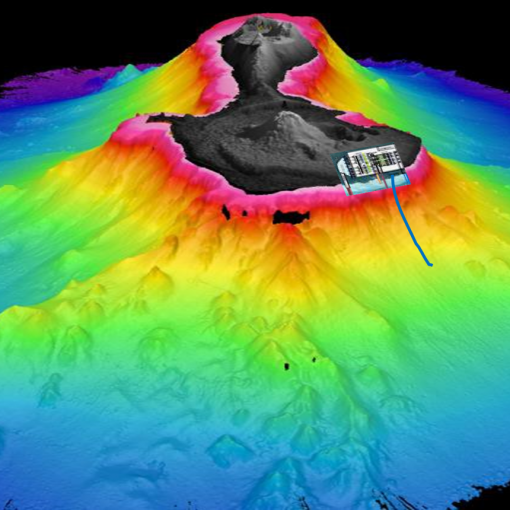
- The two largest islands Vita Levu and Vanua Levu have older volcanic systems with a number of thermal springs with Vanua Levu having the greatest geothermal potential. The third largest island Taveuni has the most recent volcanic activity with 34# Holocene eruptive periods (most recent ~500yrs ago).