Green hydrogen has long been waiting for its moment in the South African sun. Now UK funding is making it possible.
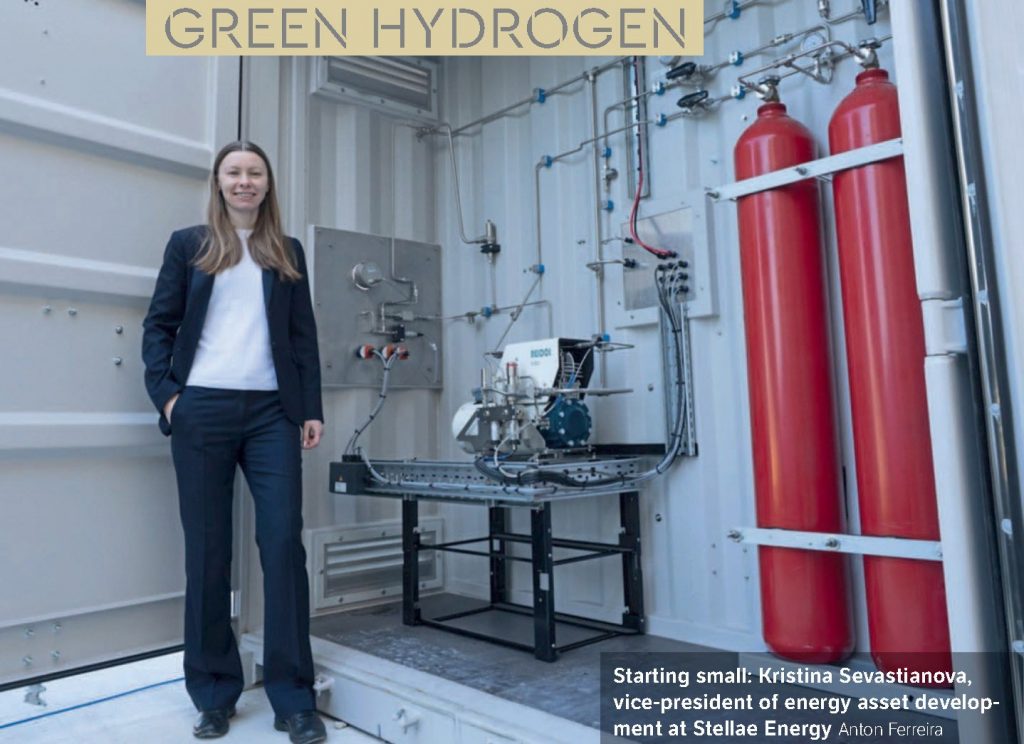
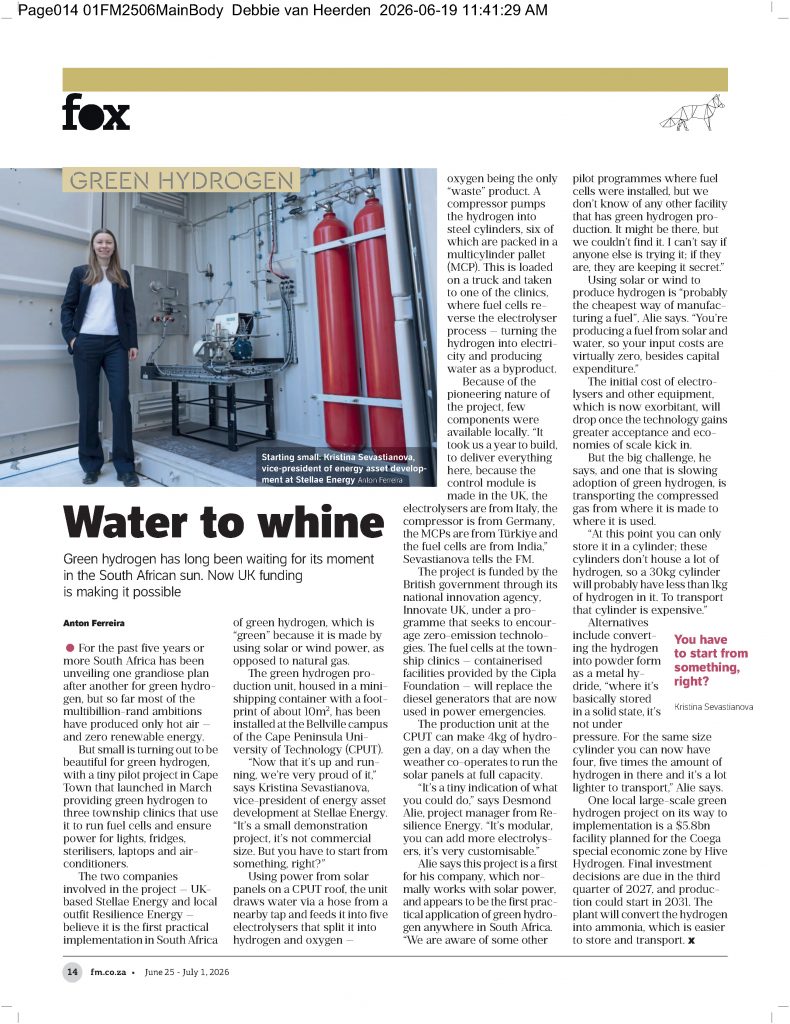
| Starting small: Kristina Sevastianova,vice-president of energy asset develop-ment at Stellae Energy |
For the past five years or more South Africa has been unveiling one grandiose plan after another for green hydro-gen, but so far most of the multibillion-rand ambitions have produced only hot air and zero renewable energy.
But small is turning out to be beautiful for green hydrogen, with a tiny pilot project in Cape Town that launched in March providing green hydrogen to three township clinics that use it to run fuel cells and ensure power for lights, fridges, sterilisers, laptops and air-conditioners.
The two companies involved in the project – UK-based Stellae Energy and local outfit Resilience Energy – believe it is the first practical implementation in South Africa of green hydrogen, which is “green” because it is made by using solar or wind power, as opposed to natural gas. The green hydrogen pro-duction unit, housed in a mini-shipping container with a foot-print of about 10m², has been installed at the Bellville campus of the Cape Peninsula Uni-versity of Technology (CPUT). “Now that it’s up and run-ning, we’re very proud of it,” says Kristina Sevastianova, vice-president of energy asset development at Stellae Energy. “It’s a small demonstration project, it’s not commercial size. But you have to start from something, right?”
Using power from solar panels on a CPUT roof, the unit draws water via a hose from a nearby tap and feeds it into five electrolysers that split it into hydrogen and oxygen oxygen being the only “waste” product. A compressor pumps the hydrogen into steel cylinders, six of which are packed in a multicylinder pallet (MCP). This is loaded on a truck and taken to one of the clinics, where fuel cells re-verse the electrolyser process — turning the hydrogen into electri-city and producing water as a byproduct.
Because of the pioneering nature of the project, few components were available locally. “It took us a year to build, to deliver everything here, because the control module is made in the UK, the electrolysers are from Italy, the compressor is from Germany, the MCPs are from Türkiye and the fuel cells are from India,” Sevastianova tells the FM. The project is funded by the British government through its national innovation agency, Innovate UK, under a programme that seeks to encour- age zero-emission technolo-gies. The fuel cells at the town-ship clinics – containerised facilities provided by the Cipla Foundation – will replace the diesel generators that are now used in power emergencies.
The production unit at the CPUT can make 4kg of hydro-gen a day, on a day when the weather co-operates to run the solar panels at full capacity. “It’s a tiny indication of what you could do,” says Desmond Alie, project manager from Re-silience Energy. “It’s modular, you can add more electrolys-ers, it’s very customisable.”
Alie says this project is a first for his company, which nor-mally works with solar power, and appears to be the first prac-tical application of green hydro-gen anywhere in South Africa. “We are aware of some other pilot programmes where fuel cells were installed, but we don’t know of any other facility that has green hydrogen pro-duction. It might be there, but we couldn’t find it. I can’t say if anyone else is trying it; if they are, they are keeping it secret.”
Using solar or wind to produce hydrogen is “probably the cheapest way of manufac-turing a fuel”, Alie says. “You’re producing a fuel from solar and water, so your input costs are virtually zero, besides capital expenditure.”
The initial cost of electro-lysers and other equipment, which is now exorbitant, will drop once the technology gains greater acceptance and eco-nomies of scale kick in. But the big challenge, he says, and one that is slowing adoption of green hydrogen, is transporting the compressed gas from where it is made to where it is used.
“At this point you can only store it in a cylinder; these cylinders don’t house a lot of hydrogen, so a 30kg cylinder will probably have less than 1kg of hydrogen in it. To transport that cylinder is expensive.”
Alternatives include convert-ing the hydrogen into powder form as a metal hy-dride, “where it’s basically stored in a solid state, it’s not under pressure. For the same size cylinder you can now have four, five times the amount of hydrogen in there and it’s a lot lighter to transport,” Alie says.
One local large-scale green hydrogen project on its way to implementation is a $5.8bn facility planned for the Coega special economic zone by Hive Hydrogen. Final investment decisions are due in the third quarter of 2027, and produc-tion could start in 2031. The plant will convert the hydrogen into ammonia, which is easier to store and transport.