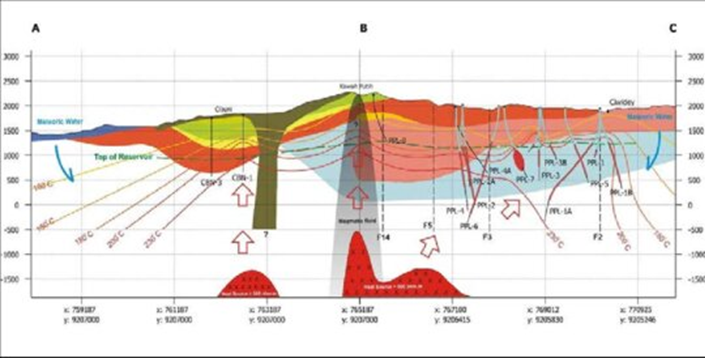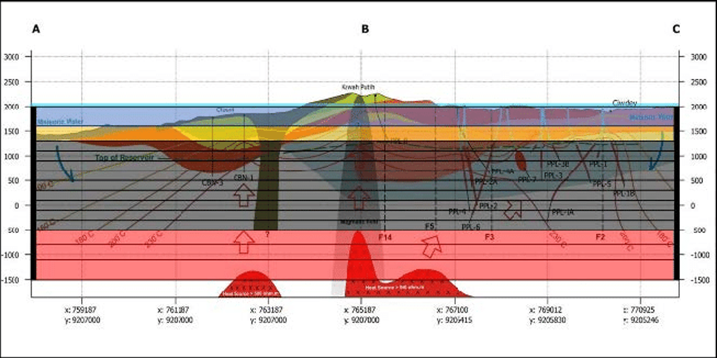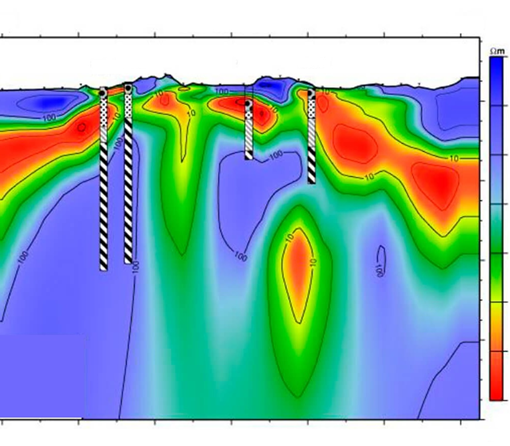
- Volcanic Geothermal Systems need to be modelled to be able to help understand the thermal energy potential and how wells could be configurated to efficiently and reliably extract the heat required to produce Geothermal electricity in the surface facilities.
- A 3D conceptual geological model is used visualise and represent the physical and geological characteristics of the geothermal reservoir. Contains lithology, faults, fluid flow paths, permeability zones, heat sources based on exploration data.
- A numerical model of the geothermal area translates the 3D conceptual model into a mathematical representation to simulate fluid flow, heat transfer, pressure changes and other dynamic processes. Software uses thermodynamics and fluid mechanics laws.
- Natural State model represents the geothermal system in its undisturbed, steady state condition, describing how the system naturally behaves w.r.t. temperature, pressure, fluid flow. It can be a component of the numerical simulation model to calibrate pre-exploitation conditions of the geothermal system and validate the numerical simulation
- Altar et al described the “typical lifecycle of a volcanic hosted hydrothermal system: (1) a magmatic intrusion forms at depth; (2) meteoric fluids find their way to the intrusion through fractures in the rocks and heated up; (3) a convection cell develops; and finally, (4) complex fluid-rock interactions initiate due to fluid flow and high temperatures, resulting in mineral alteration, fluid chemistry evolution and porosity and permeability changes within the host lithologies.” (https://doi.org/10.1016/j.geothermics.2024.103132) This life cycle needs to be represented in the preparation of these models and calibrated against the measured data prior to drilling and development.
- The numerical simulation model can also be used to test potential modifications to the development concept and during field operations to check reservoir behaviour and performance.