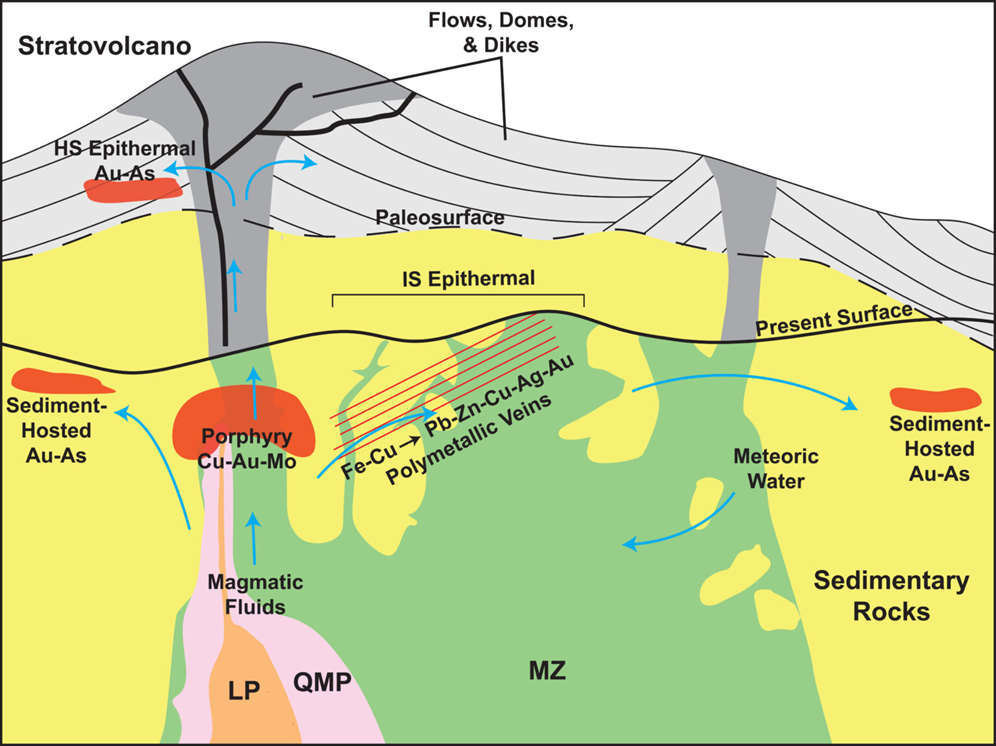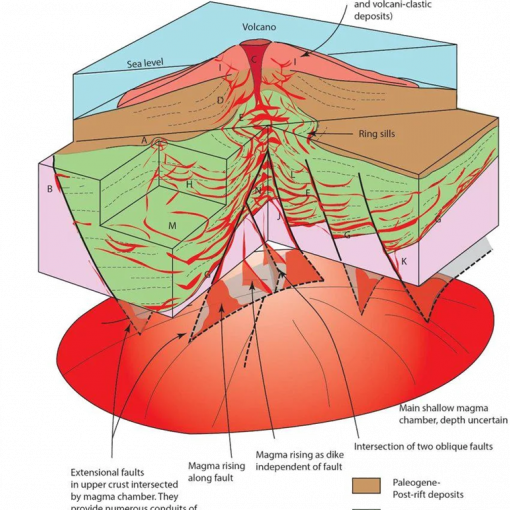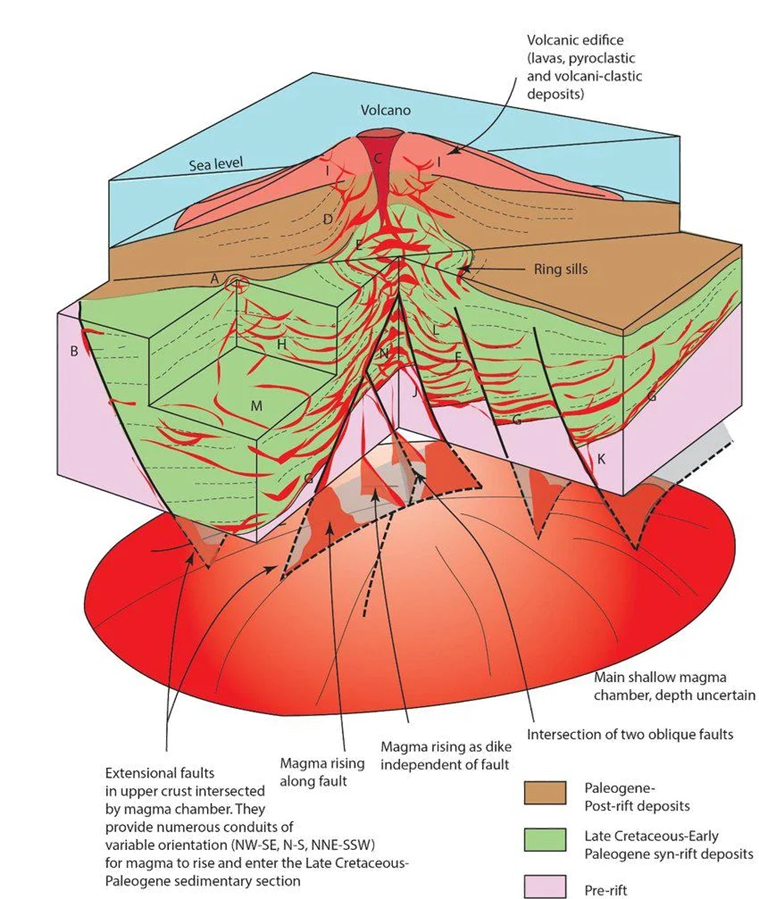
Volcanic systems such as stratovolcanoes or caldera can host both mineralisation and geothermal manifestations.
Stratovolcanoes would have had steep topography (prior to any erosion or collapse) and radial dipping sequences of permeable and impermeable rocks that means groundwater flow is directed laterally down the flanks. Hydrothermal fluids rising in the core of these systems are then directed outwards by lateral flow in permeable rock layers. Deposits are more likely to form on the flanks of stratovolcanoes.
- Calderas form by volcanic edifice collapse into the underlying space vacated by magma removal during volcanic eruptions. Calderas can be divided into larger ignimbrite calderas formed by eruption of large-volume silicic ignimbrites and smaller calderas formed near the tops of stratovolcanoes
- Epithermal gold-silver deposits form along ring fracture fault zones of ignimbrite calderas and in the collapsed interiors of both types of calderas.
- Epithermal deposits form from either near-neutral pH fluids or acidic fluids and evidence of alteration mineral zonation in geothermal fields is similar to zonation in epithermal deposits – differences in alteration mineralogy is related to differences in fluid chemistry and temperature.
- Precipitation of sulphide minerals and precious metals in geothermal systems has shown that geothermal fluids can transport minerals to epithermal ore bodies.