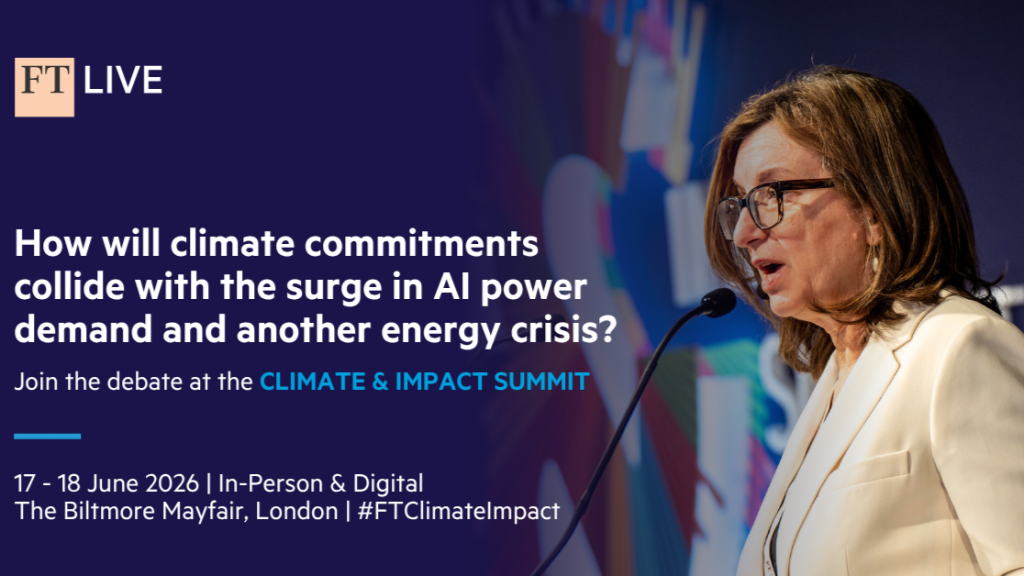
As we head into Financial Times Climate & Impact summit in mid‑June 2026, the theme is impossible to ignore: #AI is growing faster than the world’s ability to power it sustainably.
Data‑centre electricity demand is set to triple by 2030, and water consumption for cooling is rising in parallel. Nations are discovering that their climate commitments – already ambitious – were never designed for the exponential curve of AI compute.
But this is not a story of limits. It’s a story of redesign.
If AI is going to scale without overwhelming grids, draining water systems, or derailing net‑zero pathways, we need a new architecture for digital infrastructure. Three solutions stand out as both credible and actionable.
1. Localisation: Build Compute Where Clean Energy Already Exists
For decades, we built data centres where energy was cheap and connectivity was strong. That era is over.
The new model is simple: Move compute to energy, not energy to compute.
Localisation means placing AI infrastructure directly on top of clean, abundant, climate‑secure energy sources – high solar radiation regions, hydropower basins, high‑wind corridors, and regions with natural cooling advantages.
This shift reduces:
- grid congestion
- transmission losses
- fossil‑backup reliance
- water stress in vulnerable regions
It also supports sovereign compute, especially for emerging economies seeking digital independence.
Localisation is no longer an efficiency strategy; it’s a climate‑alignment strategy.
2. Miniaturisation: Smaller Models, Smaller Footprint
The AI industry is finally confronting a truth it has avoided for years: bigger models are not always better models.
Miniaturisation is happening across three layers:
- Model miniaturisation – distillation, sparse architectures, retrieval‑augmented generation
- Hardware miniaturisation – edge accelerators, neuromorphic chips, photonic processors
- Data miniaturisation – curated datasets, synthetic data, efficient training loops
These innovations reduce energy consumption by 10 – 100×, cut cooling loads, and enable AI to run closer to the edge – where energy is cheaper, cleaner, and more resilient.
Miniaturisation is the only pathway that reduces demand at the source.
3. Intelligent Energy Use: AI That Optimises Its Own Consumption
The most transformative shift is this: AI can learn to manage its own energy footprint.
We are entering an era of energy‑intelligent AI, where systems automatically adjust their behaviour based on real‑time conditions:
- shifting workloads to periods of renewable surplus
- scaling models up or down based on task complexity
- predicting cooling needs and reducing water use
- throttling inference during grid stress
- routing compute to the lowest‑carbon region available
This is AI as an active participant in climate mitigation – not just a consumer of resources.
A New Climate‑Aligned AI Architecture
Taken together, these three shifts – #localisation, #miniaturisation, and #intelligent optimisation -form the blueprint for a future where AI growth and climate commitments reinforce each other rather than collide.
How do we build AI infrastructure that is not only powerful, but planet‑compatible? This is the conversation humanity must lead: Because the question is no longer whether AI will reshape the world. It’s whether we can reshape AI to fit the world we are trying to protect.