Volcanic Geothermal Systems can have important surface manifestations of hot springs that represent leakage of fluids from hydrothermal reservoirs below. Both shallow and deep reservoirs can have thermal upflow circulation and pressure that may help induce these flows to the surface up fault and fracture systems. The amount of flow would be a function of the effective permeability of these systems.
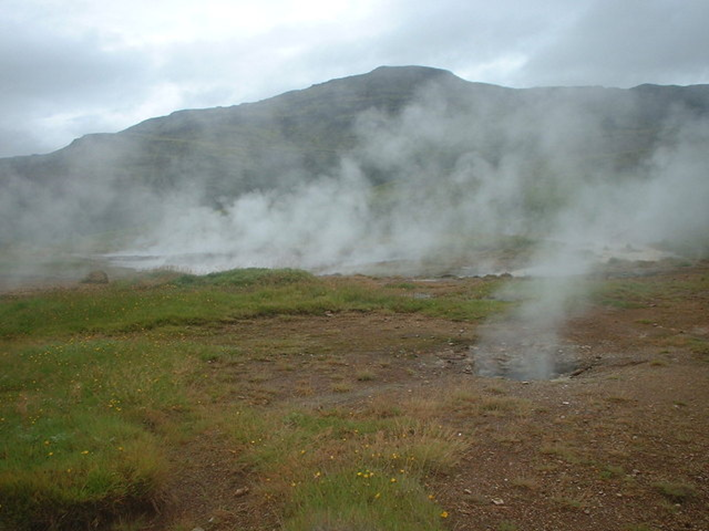
- Shallow Hydrothermal Reservoirs can be pressurised liquid dominated or pressurised liquid with steam caps. As fluids release from these reservoirs and migrate up to the surface, the pressure declines and steam may be formed at the surface (as shown in this photograph).
- Water sources can range from recycled meteoric water (rain) to connate water (sedimentary sources) to juvenile water (magmatic sources). For volcanic island arcs, there may be seawater ingress if the reservoir is near the coastline. Different water chemistries would help reveal the sources. Water fed by hydrothermal fluids can be (1) acidic sulfate, oxidised to form H2SO4 with low pH values; (2) alkaline chloride, dissolved chloride salts reacted with silicate rocks at high temperature.; or (3) bicarbonate, CO2 from carbonate rocks.
- Both conductive and convective heat sources can provide heat to the water released to these hot springs and the surface temperatures are only part of the story. Measuring high surface temperatures is a good indication that the underlying hydrothermal reservoirs are hot, but there are reasons why the surface temperatures may be lower even though the reservoirs are hot. As water is released and migrates upwards to these springs, the temperature could decline due to natural conductive cooling by reduced temperatures in the surrounding ground sediments or rocks. Cooler meteoric or surface water flows may also dilute and cool the hot fluids as they near the surface. The use of hot springs to help focus exploration to look for shallow hydrothermal reservoirs is an important tool.